

S. Ahmad
Khanij Bidesh India Limited (KABIL) is a joint venture of National Aluminium Company Ltd. (NALCO), Hindustan Copper Limited (HCL) and Mineral Exploration & Consultancy Limited (MECL) under the Ministry of Mines, established to secure India’s supply of critical and strategic minerals by identifying, exploring, acquiring and developing mineral assets overseas. Its mandate is to strengthen the domestic value chain for emerging technologies and clean-energy industries, giving a strong push to the Make in India initiative.
India stands at a decisive moment in its technological and industrial journey. The country’s ambitions in electric mobility, renewable energy, electronics manufacturing, aerospace, and defence are widely discussed. Yet, beneath these visible sectors lies a quieter but far more decisive foundation: advanced materials. Among them, rare earth permanent magnets have emerged as one of the most strategically critical components of modern technology. Compact in size but immense in power, these magnets drive electric vehicle motors, wind turbine generators, consumer electronics, industrial automation, and sensitive defence platforms. Without secure access to these materials, India’s aspirations for technological leadership risk remaining incomplete.
It is in this context that the Government of India’s approval of a ₹7,280 crore scheme to establish an integrated domestic rare earth permanent magnet manufacturing ecosystem assumes historic importance. This initiative is not merely another industrial incentive programme. It represents a structural correction to one of India’s most persistent strategic vulnerabilities. For decades, India has depended heavily on imports for permanent magnets, particularly from China, which dominates global supply chains. Such dependence exposes critical sectors to price volatility, supply disruptions, and geopolitical pressures. In an era where technology and national security are deeply intertwined, this dependence is no longer sustainable.
At the heart of the scheme is the creation of 6,000 metric tonnes per annum of domestic manufacturing capacity for rare earth permanent magnets. This capacity will span the entire value chain, beginning with rare earth oxides and extending to finished high-performance magnets. This end-to-end approach is crucial. Merely extracting minerals is not enough. True technological sovereignty comes from the ability to process raw materials, convert them into advanced components, and integrate them into high-value products.
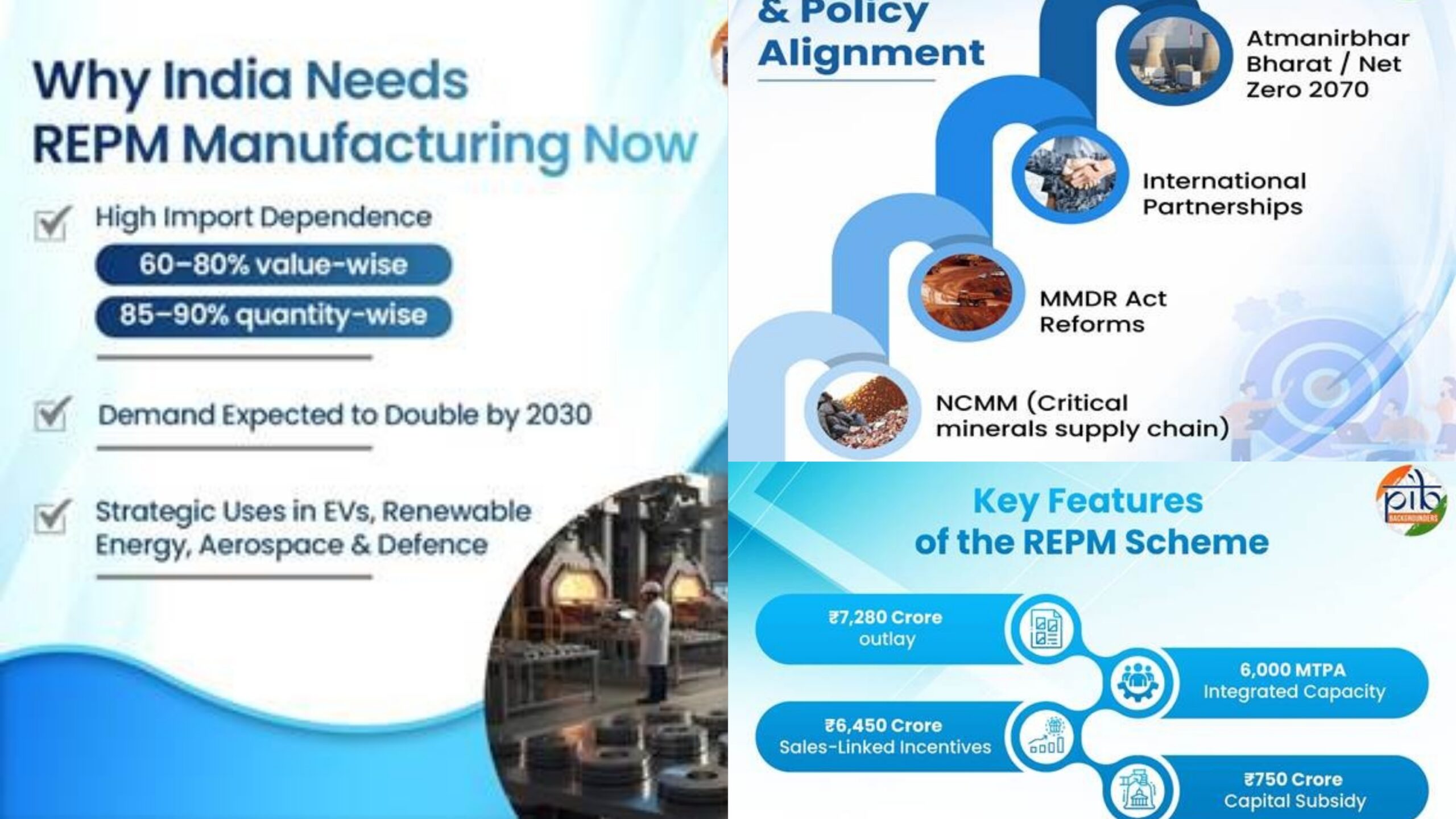
The scale of India’s import dependence highlights the urgency of this intervention. Between 2022–23 and 2024–25, India’s reliance on imported permanent magnets ranged from nearly 60 per cent to over 80 per cent by value. In terms of physical quantity, dependence exceeded 85 per cent. These figures reveal a stark reality. Even as India rapidly expands its electric vehicle production, renewable energy installations, and electronics manufacturing, it remains vulnerable at the very foundation of these industries. A disruption in magnet supply can stall entire production lines.
Ironically, this dependence persists despite India’s considerable natural advantage. The country possesses one of the world’s largest rare earth resource bases. Deposits of monazite-bearing sands are spread across coastal and inland regions of Andhra Pradesh, Odisha, Tamil Nadu, Kerala, West Bengal, Jharkhand, Gujarat, and Maharashtra. Together, these deposits contain an estimated 7.23 million tonnes of rare earth oxides. Additional in-situ resources in Gujarat and Rajasthan, along with extensive discoveries by the Geological Survey of India, further strengthen India’s position. The challenge, therefore, has never been the absence of resources. The real challenge has been the lack of integrated industrial capability to transform these resources into strategic products.
The new rare earth permanent magnet scheme directly addresses this gap. It aims to convert geological potential into industrial strength. The scheme’s structure reflects both ambition and balance. Manufacturing capacity will be distributed among up to five beneficiaries, each with a maximum capacity of 1,200 metric tonnes per annum. This prevents excessive concentration while ensuring scale and competitiveness. Of the total financial outlay, ₹6,450 crore has been earmarked as sales-linked incentives to be disbursed over five years. This ensures that incentives reward actual production and market performance. An additional ₹750 crore has been allocated as capital subsidy to support the establishment of technologically advanced facilities. The overall implementation period spans seven years, including a two-year gestation phase, providing manufacturers with stability and policy certainty.
The importance of this initiative becomes even clearer when future demand is considered. India’s consumption of rare earth permanent magnets is projected to double by 2030. This growth will be driven primarily by electric vehicles, renewable energy systems, electronics manufacturing, and strategic applications. Electric vehicles rely on high-performance magnets for efficient and compact motors. Wind turbines use them for reliable and low-maintenance power generation. Defence systems depend on them for precision, durability, and performance under extreme conditions. Without domestic capacity, India risks becoming a large market permanently dependent on foreign suppliers for the most critical components of its growth sectors.
This is why rare earth permanent magnets are increasingly viewed as instruments of technological sovereignty. In the twenty-first century, industrial power is not defined solely by software capabilities or digital platforms. It is equally defined by control over advanced materials that make machines move, generate power, and deliver precision. Countries that dominate these material supply chains shape the future of manufacturing and technology.
The rare earth permanent magnet initiative also aligns closely with India’s broader national priorities. It strengthens the vision of Atmanirbhar Bharat by reducing import dependence in a strategically sensitive sector. It directly supports India’s Net Zero 2070 commitment by ensuring a reliable domestic supply of magnets essential for energy-efficient motors and renewable energy systems. It complements defence indigenisation by ensuring that critical components are available within national borders, reducing strategic vulnerability during crises.
Importantly, this scheme is not an isolated policy decision. It fits into a larger and evolving framework aimed at strengthening India’s critical minerals ecosystem. The National Critical Minerals Mission, approved in January 2025, seeks to ensure sustainable supply across the entire value chain, from exploration and mining to processing, manufacturing, and recycling. Legislative reforms, including amendments to the Mines and Minerals (Development and Regulation) Act in 2023, have opened exploration and mining of critical and deep-seated minerals to private participation. A new exploration licence regime has been introduced, and the government has been empowered to auction mineral concessions. Together, these reforms aim to move India from a resource-rich but processing-poor economy to a fully integrated critical-minerals power.
India’s strategy also recognises that domestic capability must be complemented by global engagement. Rare earth supply chains are deeply global, and recent disruptions have demonstrated the risks of geographic concentration. To address this, India has entered into bilateral partnerships with mineral-rich countries such as Australia, Argentina, Zambia, and Mozambique. It is also an active participant in multilateral platforms like the Minerals Security Partnership and the Indo-Pacific Economic Framework. Khanij Bidesh India Limited, a joint venture of leading public sector enterprises, is pursuing overseas mineral assets to secure raw material supplies for domestic manufacturing. These international efforts do not replace domestic capacity. Instead, they strengthen it by diversifying supply sources and enhancing resilience.
The establishment of an integrated rare earth permanent magnet ecosystem, therefore, represents more than a response to immediate supply risks. It is a long-term investment in industrial competitiveness. Advanced materials form the base of modern value chains. Countries that master them gain influence far beyond their borders. By entering this space with intent, scale, and policy coherence, India positions itself not merely as a consumer of advanced technologies, but as a contributor to global clean energy, mobility, and strategic manufacturing ecosystems.
The true test of this initiative will lie in execution. Success will depend on effective technology absorption, skilled workforce development, environmental safeguards, and sustained policy support. If implemented well, the scheme has the potential to generate high-quality employment, attract technology-driven investment, and anchor a new ecosystem of advanced manufacturing in India.
As India moves toward the vision of Viksit Bharat @2047, the ability to power vehicles, grids, factories, and defence systems with domestically produced, high-performance materials will be a defining measure of its industrial maturity. The rare earth permanent magnet initiative signals that India is no longer content with being a peripheral player in global value chains. It is beginning to think, plan, and act at the scale required to shape its technological future.
India’s End-to-End Value Chain Strategy
Critical minerals are a set of naturally occurring elements and compounds that have diverse irreplaceable industrial applications.
Given their central role in contemporary industrial economies, enabling technological advancements and boosting economies, access to critical minerals has become a strategic priority for India.
Approved in January 2025, the NCMM aims to secure a long-term sustainable supply of critical minerals and strengthen India’s critical mineral value chains encompassing all stages from mineral exploration and mining to beneficiation, processing, and recovery from end-of-life products.
Mining Reforms for Critical Minerals
Mines and Minerals (Development and Regulation) Act, 1957 (MMDR Act) was enacted for regulation of mines and development of minerals. It has been reformed under the Mines and Minerals (Development and Regulation) Amendment Act, 2023 to strengthen India’s critical minerals ecosystem (for critical and deep-seated minerals) by opening private participation in all spheres of mineral exploration, empowering the Government to auction mineral concessions, and introducing a new exploration license regime.
The article is based on the inputs and background information provided by the Press Information Bureau (PIB) Author is Writer, Policy Commentator. He can be mailed at kcprmijk@gmail.com
Comments are closed.