

Firdous Ahmad Najar
“Despite unprecedented access to education, the world continues to face wars, inequality, and moral decline. This forces us to ask whether we are educating whole human beings or merely training fragmented roles.”
Education is universally acknowledged as one of the most powerful instruments for nurturing human potential, strengthening societies, and fostering peaceful nations. Yet, despite an unprecedented expansion in access to education, the world continues to grapple with wars, terrorism, corruption, inequality, unemployment, moral decline, and growing intolerance. This striking contradiction compels us to reflect on a fundamental question: are we truly educating human beings in their entirety, or merely providing fragmented training for fragmented roles?
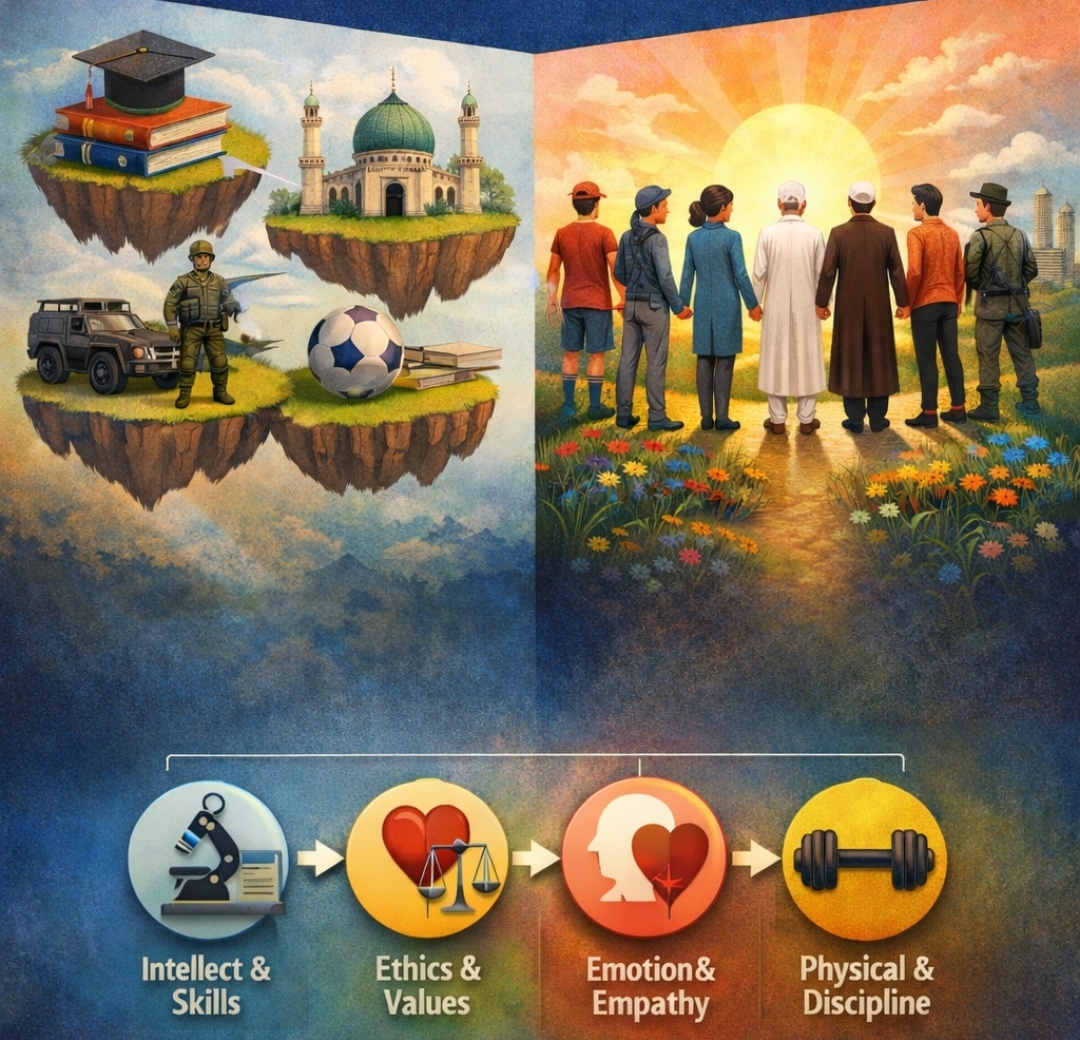
The prevailing educational landscape in many parts of the world reveals a deep imbalance in the way knowledge, skills, and values are imparted to learners. Various educational institutions: academic schools, religious seminaries, sports academies, military institutions, and vocational training centers, often operate in isolation, each emphasizing a particular dimension of human development while neglecting others. Such a compartmentalized approach may produce skilled specialists, but it seldom nurtures well-rounded human beings. The lack of harmony among intellectual, moral, emotional, and physical development has emerged as a silent yet powerful contributor to the global human crisis.
Fragmentation at the Core of Modern Education:
Traditional academic institutions largely emphasize intellectual and cognitive development. Students are trained to memorize information, analyze data, solve theoretical problems, and achieve high scores in examinations. Such intellectual rigor is undeniably essential for progress in science, technology, commerce, and innovation. However, when academic achievement becomes the sole indicator of success, education loses its human soul.
Many graduates emerge intellectually sharp but emotionally fragile, socially disconnected, and ethically confused. They may know how to design systems or manipulate data, yet struggle to navigate moral dilemmas, interpersonal conflicts, or civic responsibilities. Knowledge without empathy and ethics risks becoming a tool of dominance rather than service.
In contrast, religious and faith-based institutions focus primarily on moral values, spiritual discipline, humility, compassion, and devotion. They remind learners that every religion is a path of worship to Almighty Allah and that respect for diversity is central to human brotherhood. These institutions play a vital role in preserving moral consciousness. Yet, when moral education is disconnected from scientific literacy, technological competence, and economic skills, students may remain ethically strong but economically vulnerable. Moral depth alone cannot ensure dignity without employable skills.
Sports academies and military institutions offer another dimension of development, excelling in discipline, resilience, physical fitness, teamwork, and courage. These qualities are essential for national strength and personal confidence. However, when physical and tactical training is not guided by ethical reasoning, emotional intelligence, and social responsibility, it risks producing strength without compassion and authority without accountability.
Artistic education, too, faces fragmentation. Art nurtures creativity, sensitivity, expression, and cultural identity. Yet, when artistic freedom is detached from empathy and social consciousness, it can lose its transformative potential and fail to respond meaningfully to human suffering.
Across domains: academic, religious, physical, artistic, and vocational;the same pattern persists, education operates in silos, producing isolated competencies rather than integrated personalities.
Consequences of an Imbalanced Educational System:
The consequences of this fragmented educational approach are visible across societies. The crises confronting the modern world are not merely political or economic; they are deeply human crises shaped by educational imbalance.
Science without humanity has led to weapons of mass destruction, environmental devastation, and unethical technological misuse. Commerce without morality has normalized corruption, greed, and inequality. Art without compassion has sometimes fueled division rather than healing. Sports and defense training without ethics have fostered arrogance and misuse of power. Religious and ethical education without skills and technological awareness has contributed to unemployment and dependency.
As a result, societies witness scholars without employability, athletes without empathy, and professionals without moral restraint. Doctors, engineers, and scientists, armed with immense knowledge, sometimes misuse their expertise and, instead of easing human suffering, contribute to corruption and destruction. When education develops one dimension at the cost of others, it produces incomplete individuals incapable of sustaining peace, coexistence, and social harmony.
The persistence of global crises despite rising literacy and higher education reveals a hard truth: education that neglects human values cannot safeguard humanity.
The Shift Toward Holistic Education, and Its Limitations:
Recent educational reforms, including the New Education Policy (NEP), mark an important transition from narrow, single-domain development toward holistic development. This shift acknowledges that education must nurture multiple dimensions of the learner rather than focus solely on academic achievement. It is a welcome and necessary step forward.
However, holistic development alone is not sufficient unless it is guided by an integrated vision. Learners pursue different career paths: science and technology, commerce, arts, military and athletics, religious studies, artificial intelligence, and vocational trades, based on aptitude and aspiration. While curricula may rightly differ to support these diverse goals, education must not lose a shared national and human purpose.
There must be one unifying aim that binds all educational pathways: national progress, human brotherhood, and global peace. Without this shared moral and civic direction, even holistic education risks becoming fragmented, producing well-developed individuals who move in conflicting directions rather than toward collective harmony.
The Need for an Integrated Educational Vision:
The challenges of the 21st century: climate change, artificial intelligence, economic disparity, social polarization, and global conflict; cannot be addressed by intellectual brilliance alone. They require morally conscious, emotionally mature, socially responsible, and physically resilient individuals.
An integrated model of education does not reject specialization; it humanizes it. Science and technology must serve humanity, commerce must operate within ethical limits, military and athletic strength must be guided by compassion, and religious education must empower learners with skills for dignified living.
Such a model rests on five foundational pillars:
Values-Centered Education:
Education must consciously and explicitly nurture empathy, integrity, justice, humility, ethical reasoning, and respect for diversity. Students should be guided to understand that all religions represent unique and sincere expressions of devotion to Almighty Allah, and therefore every individual, regardless of belief, deserves dignity, compassion, and mutual respect. Such an approach fosters peaceful coexistence and social harmony. Moral and values education should not remain an optional or peripheral component of schooling; rather, it must form the foundational framework upon which all academic learning and personal development stand.
Holistic Human Development:
True education must foster a balanced development of the intellectual, emotional, physical, moral, and spiritual dimensions of the learner, as lasting progress depends on the harmonious growth of all these aspects. It should equip students with relevant skills and prepare them for careers in fields such as science, technology, commerce, religious studies, and artificial intelligence, without allowing these goals to overshadow fundamental human values. Moral and academic learning must lead to economic dignity, enabling individuals to earn a livelihood with integrity and self-respect. Knowledge acquires its true purpose when guided by conscience, emotional intelligence, and spiritual awareness, ensuring that ethics and employability strengthen one another and that education serves both economic advancement and the creation of peaceful, humane societies.
Action-Oriented Learning:
Education must inspire students not only to understand problems but also to commit themselves to ethical solutions. This requires hands-on learning, community engagement, and real-world applications of values. Students must experience what it means to serve humanity, uplift the vulnerable, and participate in building inclusive communities.
Brotherhood and Global Citizenship:
At the heart of this integrated model lies the belief that all human beings are part of one global family. Brotherhood is not a slogan; it is a principle that guides relationships, policies, and attitudes. A peaceful world cannot be built on superiority or division—only on mutual respect, shared responsibility, and the recognition that diversity is a sign of Allah’s wisdom.
Freedom from Commercialization and Radicalization
Education must be protected from the forces that seek to commercialize knowledge for profit or manipulate it for ideological extremism. An integrated model of education revives the purpose of learning: to create good human beings, individuals who are strong in values, skilled in their professions, and dedicated to serving humanity.
To realize this integrated vision of education, curricula must deliberately embed ethics, emotional development, physical well-being, and skill formation alongside academic learning. Teachers should act as mentors of character and conscience, not merely as transmitters of information. Education must be safeguarded from excessive commercialization and political manipulation so that it remains a force for unity rather than division. Institutions, too, must move beyond isolation and competition; academic schools should learn from moral and value-based institutions, religious schools must integrate modern skills and scientific understanding, and physical training centers should consciously incorporate ethical and character education. Such collaboration can produce balanced individuals; employable scholars, compassionate athletes, and professionals who embody integrity and social responsibility.
Conclusion
A peaceful, just, and progressive world cannot be built by individuals shaped through fragmented and isolated systems of education. It requires the nurturing of complete human beings: intellectually capable, morally grounded, emotionally mature, physically disciplined, and spiritually conscious. Education must therefore return to its holistic purpose: the cultivation of humanity. When educational systems harmonize science with ethics, technology with compassion, commerce with morality, strength with empathy, and faith with skill, societies can move closer to a future where no one cries for a piece of bread, diversity is respected, peace triumphs over conflict, and individuals flourish without fear, discrimination, or violence. Such a transformation is neither idealistic nor unattainable; it is both possible and urgently necessary, provided we begin by healing education itself.
The writer is a teacher from Arin Bandipora and can be reached at njfirdous090@gmail.com
Comments are closed.