
A Quite takeover: After Abdullah, the Management of Kashmir

Mohammad Muzaffar Khan

“Abdullah remains the emotional icon; Bakshi the quiet engineer of control. One ruled hearts, the other managed moods”

The arrest of Sheikh Mohammad Abdullah in August 1953 was not merely the removal of a popular leader; it was a psychological rupture in Kashmir’s political life. For nearly a decade, Abdullah had embodied Kashmiri aspirations, dignity and emotional nationalism.
His sudden dismissal and incarceration shattered the affective bond between ruler and ruled, leaving behind a volatile political tide—charged with resentment, confusion and latent defiance. It was into this turbulent emotional landscape that Bakshi Ghulam Mohammad stepped, not as a charismatic heir or ideological visionary, but as a pragmatic manager of public psychology.
         Bakshi inherited a state whose crisis could not be solved through speeches or symbolism alone. Unlike Abdullah, whose authority flowed from personal magnetism and historical memory, Bakshi lacked organic mass appeal.
He understood, however, something more elemental about Kashmiri society: its politics were deeply emotional but not rigidly ideological; its loyalties could shift with circumstance; and its people desired peace, dignity and material security more than abstract constitutional debates. Managing the tide, for Bakshi, meant redirecting public sentiment rather than confronting it head-on.
         The first task was to neutralize the overwhelming presence of Abdullah’s legacy. His arrest had created the risk of martyrdom, a danger Bakshi sought to contain through legal, administrative and psychological means.
The Kashmir Conspiracy Case was central to this effort. By recasting Abdullah not as a wronged leader but as a potential subversive collaborating with foreign powers, the state altered the emotional grammar of public discourse. Doubt replaced reverence, and ambiguity eroded moral certainty. The narrative was no longer one of betrayal by Delhi alone, but of suspicion surrounding Abdullah himself. Whether the charges were credible mattered less than their psychological effect: the moral clarity of resistance was blurred.
         Alongside legal delegitimization came quieter, more pervasive mechanisms of control. Peace Brigades—armed civilian auxiliaries—policed neighbourhoods, conversations and gestures of loyalty. Their presence was not simply coercive but performative, reminding people that dissent was being watched, recorded and remembered. Fear worked not through spectacular violence but through everyday discipline. Public life was carefully managed, emotional excess contained, and mass mobilization pre-empted.
         Yet repression alone could not stabilize Kashmir. Bakshi understood that emotional dislocation required material reassurance. If Abdullah had ruled through sentiment, Bakshi would rule through delivery. His politics were transactional, almost theatrical.
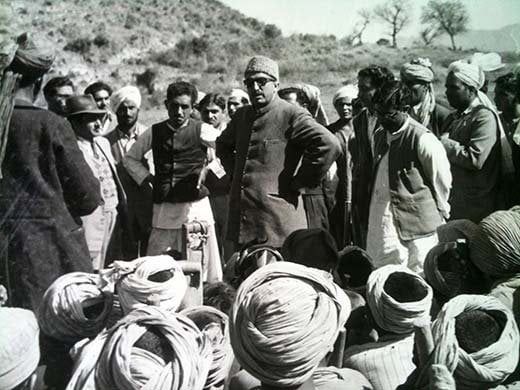
He walked among people, offering jobs on the spot, scribbling appointment orders on scraps of paper, cultivating an image of accessibility and immediacy. These gestures, widely remembered and carefully staged, created a new relationship between the state and the citizen—one based not on ideological loyalty but on tangible benefit.
         This system of patronage was expanded into a broader developmental strategy. Bakshi tied Kashmir’s political future firmly to India by securing massive central funding in exchange for the Constituent Assembly’s ratification of accession in 1954, effectively closing the plebiscite debate. Roads were built, hospitals expanded, schools and colleges opened, tourism promoted and government employment vastly increased. Kashmir was folded into India’s Five-Year Plans, and the state became one of the most grant-dependent regions in the country.
         Development functioned not just as economic policy but as psychological governance. It signaled normalcy after rupture, prosperity after uncertainty. Nehru’s belief that Kashmiris valued food, fairness and stability over ideological abstractions found practical expression under Bakshi. Material improvement softened political anger, while dependence on state largesse reshaped loyalties. Integration was achieved not through consent alone, but through everyday bureaucratic reliance.
         Symbolism, too, played its part. Bakshi carefully curated Kashmir’s image within the Indian imagination—as a peaceful, beautiful, ancient land seamlessly belonging to the nation. Tourism was encouraged not only for revenue but as emotional integration, making Kashmir visible, desirable and familiar to mainland India. At the same time, this aestheticization depoliticized Kashmir, reducing a contested political space to a scenic paradise. The very success of this imagery concealed the unresolved anxieties beneath.
Over time, however, the costs of this model became apparent. Patronage bred corruption, and loyalty became a pathway to wealth. State institutions weakened as nepotism flourished. Bakshi himself was unapologetic, reportedly remarking that if a Kashmiri could not grow rich during his rule, he never would. A new elite emerged, materially invested in the status quo but disconnected from institutional ethics. Legitimacy was maintained, but it was fragile—dependent on continued delivery and constant management.
         Bakshi’s downfall did not come from the streets but from Delhi. In 1963, under the Kamaraj Plan, removing him as part of an internal political reconfiguration. The irony was sharp: the man who had stabilized Kashmir for the Union was discarded once his utility waned. Bakshi later opposed his successor, G.M. Sadiq, and was arrested under the Defence of India Rules. He died in 1972, politically isolated and largely forgotten.
         Today, the contrast between the grave of Sheikh M Abdullah and the tomb of Bakshi Ghulam Mohammad is striking. It mirrors their legacies. Abdullah remains the emotional icon; Bakshi the quiet engineer of control. One ruled hearts, the other managed moods.
         Bakshi Ghulam Mohammad’s rule cannot be reduced to simple categories of betrayal or patriotism. He was a political realist who grasped the mutable nature of Kashmiri public psychology. By combining repression with development, symbolism with patronage, he redirected a volatile post-Abdullah tide into a controlled, if constrained, political order. His legacy is deeply paradoxical—integrative yet coercive, pragmatic yet corrosive, stabilizing yet morally ambiguous.
         In managing the tide after Abdullah’s arrest, Bakshi did not resolve Kashmir’s contradictions; he merely contained them. And in doing so, he left behind a model of governance whose consequences continue to shape the region long after the tide has shifted again.
Author Mohmad Muzaffar Khan is a Srinagar based scholar and media professional with a postgraduate degree in Mass Communication and Journalism. With seven years of experience as an active political writer, he has developed a strong reputation for analytical depth, clarity of thought, and a nuanced understanding of socio-political issues. He can be mailed at   Muzaffar.khn2010@gmail.com

Comments are closed.