

Tamanna Hazarika
“At a time when women’s participation in armed combat was almost unheard of, Fatma Seher Erden stood at the frontlines of the Turkish War of Independence. Her courage, leadership, and unwavering patriotism challenged the rigid gender norms of her era and redefined what it meant to serve the nation.”
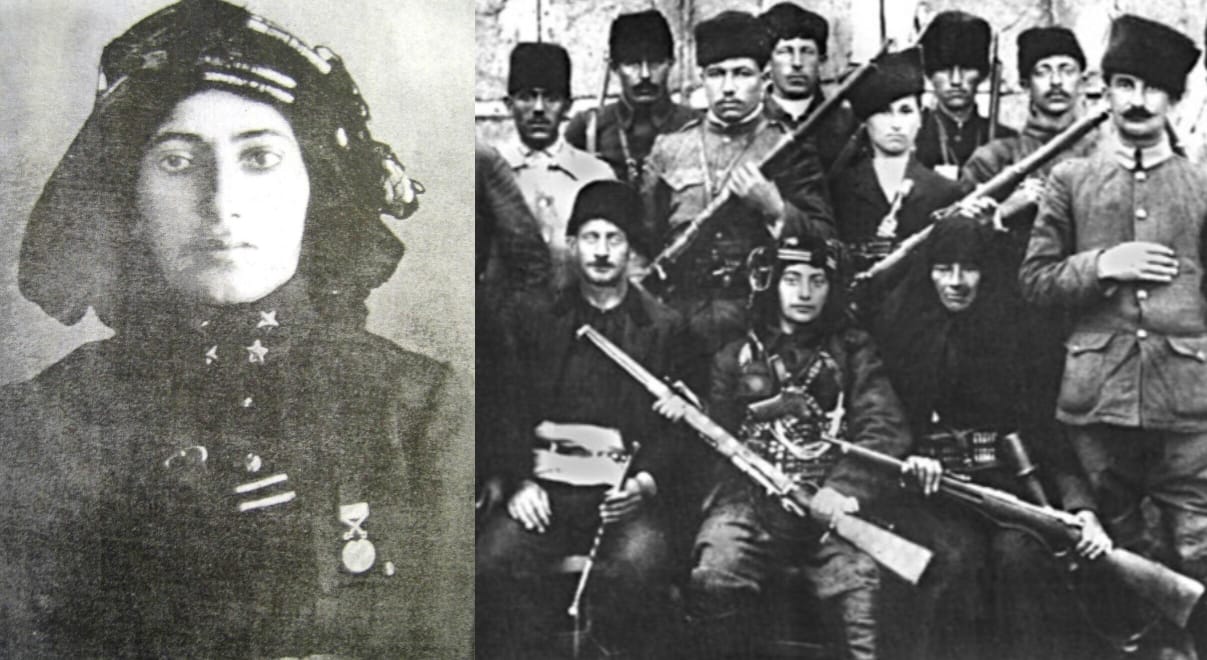
Fatma Seher Erden (1888–2 July 1955), widely known by the honorific nickname Kara Fatma, was a Turkish female soldier and one of the most remarkable militia leaders of the Turkish War of Independence. At a time when women’s participation in armed combat was almost unheard of, she distinguished herself through exceptional courage, leadership, and devotion to her country.
She was born in 1888 in Erzurum, then part of the Erzurum Vilayet of the Ottoman Empire. Her father was Yusuf Agha, and her early life was filled with turbulent conditions of the late Ottoman period. During the First World War, her husband was killed in the Caucasus Campaign. She lived on like a strong widow. In 1919, as the Ottoman Empire collapsed and the Turkish national movement began.
Fatma Seher travelled to Sivas, where Mustafa Kemal Pasha (later Mustafa Kemal Ataturk) was organizing resistance against colonial powers. There, she personally requested to be enlisted in the national forces. With Mustafa Kemal’s approval, she formed and commanded a militia unit. Under her command were approximately 700 men and 43 women, an unprecedented achievement for the period. Her bravery on the battlefield earned her the nickname ‘Kara Fatma’, given by Mustafa Kemal Ataturk himself. While the word kara literally means “black” in Turkish and refers to a warrior with courage, strength, and fearlessness.
Kara Fatma actively fought on several fronts during the Turkish War of Independence, including the Izmit–Bursa and Izmir fronts. She was captured twice by Greek forces, yet both times she managed to survive and return to the battlefield. During her second imprisonment, she was reportedly taken to the headquarters of Greek General Nikolaos Trikoupis, where the general spoke with her before she later escaped from captivity. Her determination and resilience became legendary among her comrades.
According to later accounts, Kara Fatma’s unit was among the first forces to enter Izmir during its liberation on 9 September 1922. Her troops also took control of Karsiyaka, on the northern side of the Gulf of Izmir.
She began her military career as a corporal and rose to the rank of first lieutenant. After the war, she retired from service and donated her military pension to the Turkish Red Crescent. Despite her heroic past, Kara Fatma lived in poverty for many years and was largely forgotten by the public until 1933, when a journalist discovered her living with her grandchild in a former Russian monastery in Istanbul.
In 1944, she published her memoirs, bringing renewed attention to her contributions. She was later honored by the state, employed, and recognized during national ceremonies, where her Medal of Independence was displayed. Kara Fatma spent her final years at Darul aceze Hospital, a charitable institution run by the Municipality of Istanbul, where she died on 2 July 1955. She was buried at Kulaksız Cemetery in Istanbul. She was awarded the Medal of Independence. In recent times, she remains a powerful symbol of courage among Turkish women.
References :
- Edited by Catharina Raudvere & Petek Onur. Neo-Ottoman Imaginaries in Contemporary Turkey (2022). Springer international publishing
- Kamil Cakir. Medeniyetimizin Mimarlari (2019). Gulhane Yayinlari
- Ahmet Murat Seyrek. Ataturk Sozlugu (2022). Yediveren Yayinlari
- Gozde Ozgur. Gunesin Dogusu : Ey Vatan! Gozyaslarin Dinsin. Yetistik cunkubiz (2020). Yalin Yayincilik
Tamanna Hazarika, an author based in Nagaon, Assam, writes extensively on women’s history. She can be mailed at tamannahazarikax@gmail.com
Comments are closed.