

Dr Aadil Zeffer
A child is akin to an unmarked page, and the writing placed upon it becomes lasting.
In an age that privileges credentials, career milestones and the metrics of material success- a quieter, more consequential work often goes unremarked: the moral education that parents are uniquely placed to provide. In many households today, parents take pride in their children’s academic or professional achievements.
Yet, few pause to ask: “Is my child truthful? Kind? Responsible? Does he or she respect others, including those less fortunate?” Schools can teach algebra, chemistry and coding; they can cultivate critical thinking and technical competence. But the instincts that guide a life- the propensity to tell the truth when it is costly, to show restraint when it is easier to indulge, to take responsibility when blame is the safer route, are first formed in the intimacy of the home.
If public debate about education focuses on employability and measurable outcomes, the cultivation of conscience risks receding from view. That retreat is not only a private loss; it is a civic one. Societies that produce brilliant technicians without moral grounding will quickly discover that expertise unmoored from ethics corrodes social trust and common purpose.
The present predicament is not a simple failure of intention. Most parents want what is best for their children: security, opportunity and recognition. Yet the practical pressures of modern life-long working hours, performance-driven schooling, the omnipresence of screens, and the constant pull of social comparison- shrink the time and attention available for the slow, ambiguous work of moral formation.
In such a climate, it becomes easy to equate successful parenting with securing high grades, prestigious internships or early career placements. Those achievements matter. But if they are pursued at the expense of developing empathy, honesty and a sense of responsibility, the result is a kind of hollow success- a child accomplished in the world but underprepared to serve it.
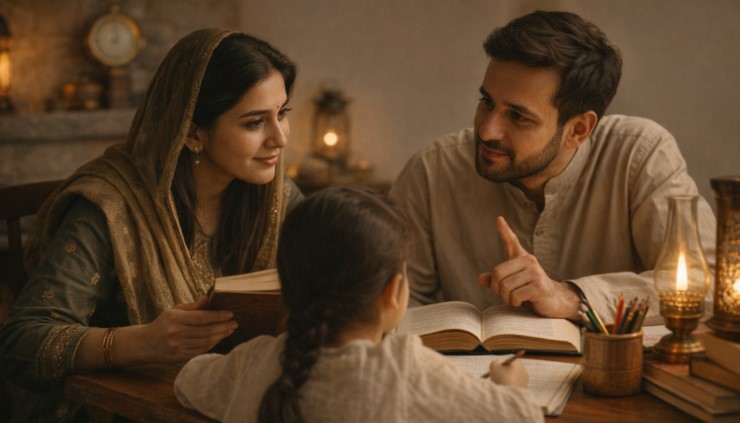
Psychologists and educators have long emphasized that children learn far more from what they observe than from what they are told. A parent’s small acts, such as the way one speaks about a neighbor, the manner in which disagreements are handled at the dinner table, the response to a cashier’s mistake, are powerful curriculum.
When honesty is modeled in everyday transactions, when mistakes are acknowledged rather than concealed, children absorb norms about integrity that no lecture can easily displace. Conversely, when parents excuse minor dishonesties or treat empathy as a dispensable nicety, children internalize a permissive moral grammar. Moral formation, in this sense, is less a course to be completed than a climate to be created.
Contemporary conversations about parenting occasionally look to international models for inspiration. In several northern European countries, for instance, there has been a notable emphasis on character education and social-emotional learning at early stages of schooling. These efforts do not replace parental responsibility; rather, they complement it by creating shared vocabularies- about fairness, respect and care- that children encounter both at home and in public institutions. Such approaches underscore an important lesson: moral formation is most resilient when it is distributed across the multiple settings a child inhabits- family, school, community and peer networks- rather than left entirely to one sphere.
A core challenge is how to combine firmness with affection. Love that is indulgent and unbounded by limits can fail to prepare children for the ethical demands of adult life; sternness without warmth hardens rather than forms. The prophetic tradition, like many ethical systems, directs parents to cultivate good manners and moral sensibilities through patient guidance and compassionate correction.
Practical parenting that draws on these resources is attentive both to character and to the conditions that shape it: the stories children hear, the routines they inhabit, and the language used to describe success and failure.
Concretely, moral formation is advanced by sustained practices that do not require grand gestures. Shared family rituals- whether a nightly conversation about the day, a weekly act of service, or a collective reflection on a difficult situation- create opportunities for children to practice empathy and judgment. Equally important is the way parents respond to failures of character.
A child who breaks a promise or tells a falsehood needs a response that holds them accountable, explains why the act was harmful, and then offers a path toward repair. Punishment that shames or humiliates corrodes trust; permissiveness that evades consequence confuses responsibility with expedience. Moral education thus unfolds through repairable mistakes, not mythical perfection.
Another dimension worth noting is the role of narrative. Children make sense of the world through stories. Families that tell stories about ordinary acts of kindness, about historical or religious exemplars who sacrificed for others, or about personal moments of moral confusion and resolution, are inviting children into a moral imagination.
Such narratives do not have to be elaborate; candid recounting of how a parent once corrected a wrong, or how a neighbor’s small kindness made a difference, becomes part of the child’s moral repertoire. Narrative conveys not only what is right but why it matters; it locates virtue within a lived human economy of relationships rather than abstract prescriptions.
A realistic account of parental responsibility must also attend to structural inequalities. Not all households have equal time, resources or social capital to devote to deliberate moral coaching. Overburdened parents juggling multiple jobs, families dealing with precarious housing, and communities that lack safe public spaces face particular constraints.
Public institutions have a role here: schools and community organizations (Masjids, NGO’s, Youth initiatives, etc.) can be partners in character formation, offering programs that are sensitive to diverse cultural contexts and that do not replicate the stigmatization of families facing hardship. Policy that supports parental leave, flexible work arrangements and affordable childcare is not merely welfare; it is moral infrastructure. By making it possible for parents to be present, society invests in the conditions in which conscience can be nurtured.
There is also a cautionary note about overzealous instrumentalization. When moral instruction is reduced to producing compliant citizens or market-ready workers, it loses its deeper aim. Ethical formation should not be measured only by how well children conform to prevailing economic demands; rather, it must aim to form persons who can judge, criticize and improve those demands. True education raises questions: whom did this policy help and whom did it harm?
Was this business decision fair? How should we weigh short-term gains against long-term harm? Encouraging such critical reflection is an essential antidote to moral complacency. The stakes of parental moral formation extend beyond the private order. A society that produces adults versed in empathy, truthfulness and responsibility lays the groundwork for institutions that are more just, economies that are more humane, and politics that are less corrosive. Conscience is not the opposite of ambition; it is its rightful companion. Parents who model service alongside success transmit a vision of flourishing that does not treat others as means to personal ends.
In the end, the proposition is simple but profound: parenting that cultivates conscience before career is an investment in both private character and public good. The daily acts of patience, the small admissions of fault, the consistent insistence that means matter as much as ends- these are the ordinary practices that yield extraordinary results. In a world of accelerating change and shifting values, the steadiness of moral formation remains an incomparable asset.
If parents can reclaim the centrality of this task- by being present, by modeling integrity, and by creating spaces for reflection- they will not only form competent individuals but also help sustain a humane society. Conscience, like character, is formed in the ordinary heart of family life; it is there, in the humble rituals of home, that the seeds of a decent and durable future are planted.
Comments are closed.