
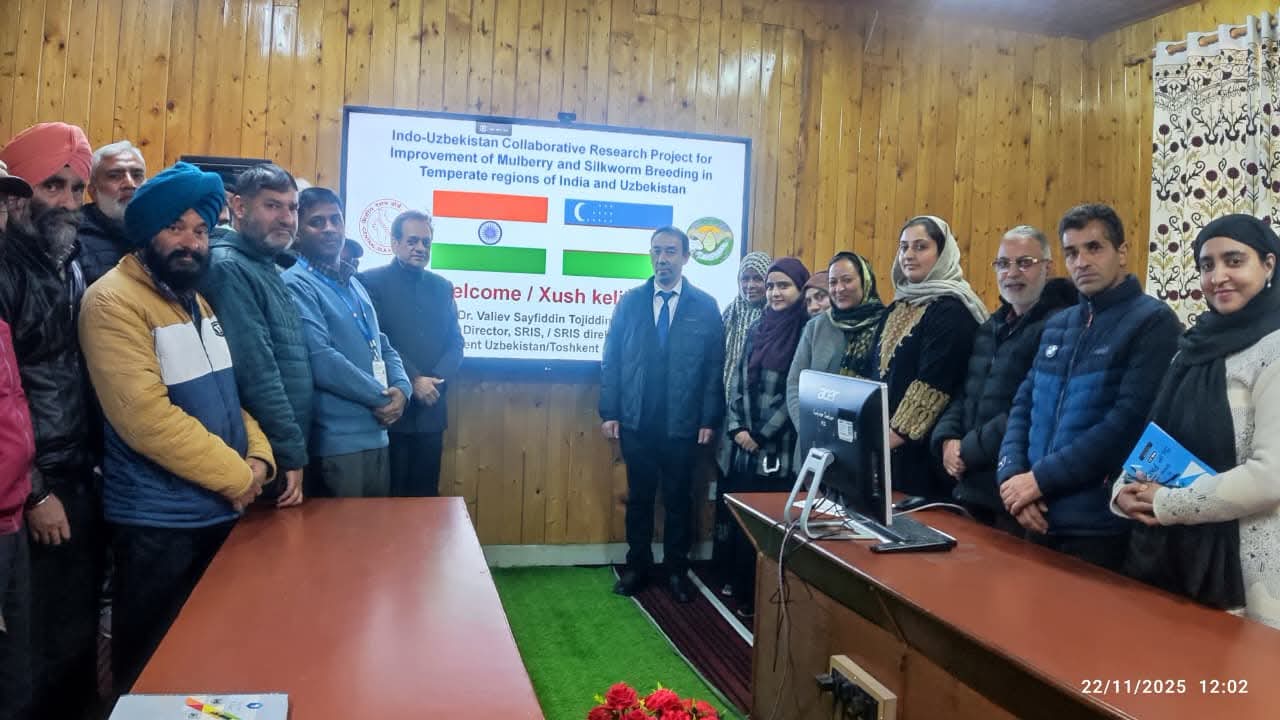
Tashkent Sericulture Director Visits CSR&TI Pampore to Strengthen Global Collaboration

Srinagar, Nov 23: Dr. Valiyev Sayfiddin Tojiddinovich, Director of the Sericulture Research Institute, Tashkent, Uzbekistan, visited the Central Sericultural Research and Training Institute (CSR&TI) of the Central Silk Board at Pampore on 22 and 23 November, marking a significant milestone in Indo-Uzbekistan cooperation in temperate sericulture.
Officials said the visit forms part of an ongoing collaborative research project between the two premier institutes.
Dr. Sardar Singh, Director CSR&TI Pampore, who had earlier visited the Tashkent institute to initiate research collaborations, welcomed Dr. Valiyev along with the institute’s scientific faculty. The two sides held extensive interactions on advancements in temperate sericulture, emerging research priorities and potential areas for deeper collaborative work.
A key highlight of the visit was the exchange of vital silkworm genetic resources under a material transfer agreement aimed at strengthening breeding programmes and developmental strategies for temperate sericulture.
During his tour, Dr. Valiyev inspected the institute’s laboratories and also visited the site of the Seri-Tourism project at Manasbal in Ganderbal. He expressed admiration for CSR&TI Pampore’s conservation efforts, particularly the maintenance of 150 temperate mulberry varieties from 20 countries and a rich repository of silkworm germplasm of Indian, Chinese, European and Japanese origin. He commended the Central Silk Board for preserving and showcasing global mulberry and silkworm diversity within Kashmir’s temperate ecosystem.
The visit is expected to pave the way for a robust long-term partnership between CSR&TI Pampore and the Sericulture Research Institute, Tashkent—one of the world’s oldest sericultural research centres. The exchange of promising genetic resources marks an important step in strengthening global genetic networks and supporting future silkworm breeding initiatives.
Dr. Valiyev also reviewed sericultural practices unique to Kashmir’s temperate climate, drawing parallels with Uzbekistan’s sericulture belts which share similar ecological characteristics. Both sides expressed confidence that enhanced collaboration would help boost high-quality bivoltine silk production in both countries.
Dr. Sardar Singh said that under the guidance of the Member Secretary, Central Silk Board, Ministry of Textiles, Government of India, the visit has opened new avenues for joint R&D projects, knowledge exchange and scientific cooperation. He noted that discussions during the visit have laid the groundwork for cooperation in genetic improvement, advanced rearing technologies and sustainable sericulture development in temperate regions.
The two-day visit marks a significant advancement in international sericulture cooperation, opening fresh opportunities for scientific innovation and mutual growth between India and Uzbekistan.
Comments are closed.