

By Muhammad Talha Amin Baruah
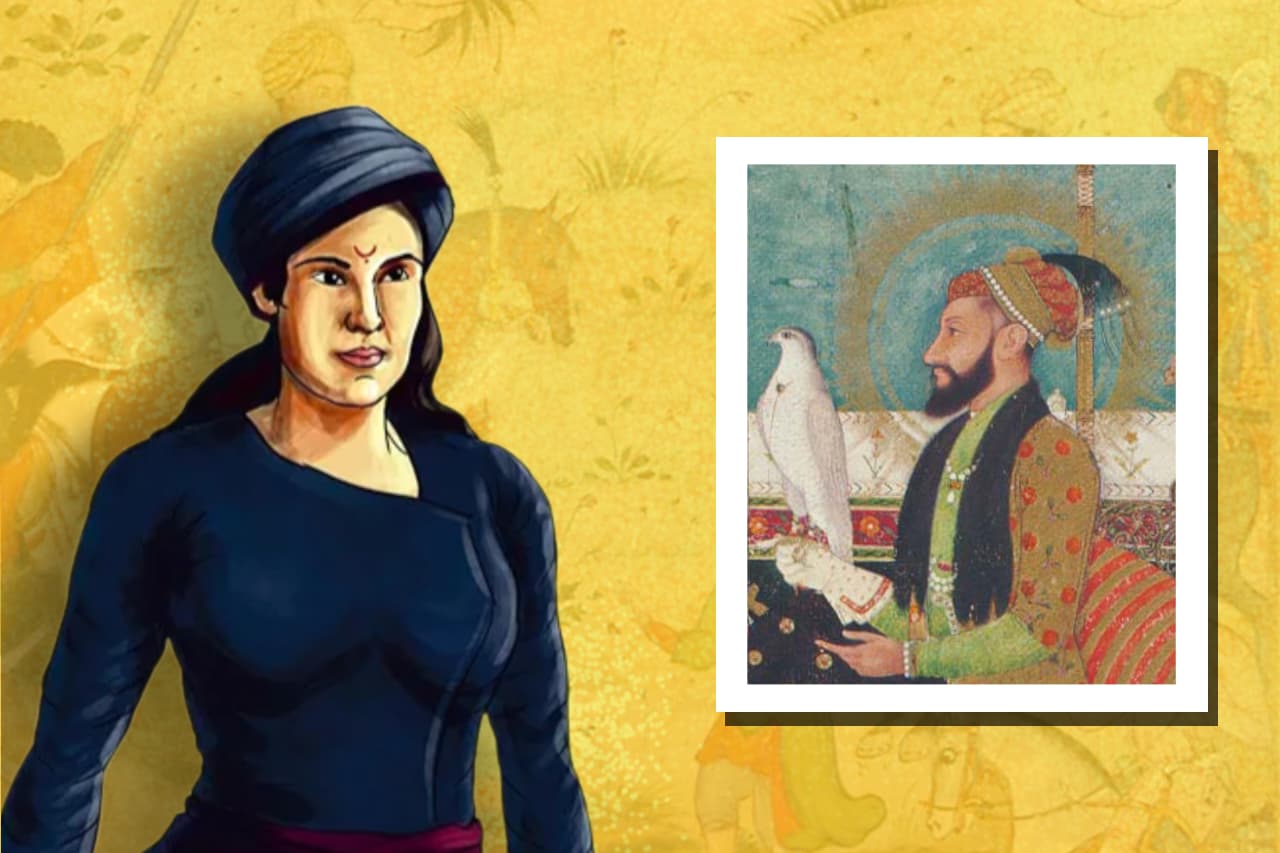
Savitribai Deshmukh, alias Rai Bagan, was a remarkable female warrior in the Mughal army, famed for her courage and leadership. Known as the “Tiger Princess”, she earned respect for her fierce fighting skills and strategic acumen during battles in the Mughal era. Despite the male-dominated military landscape, Rai Bagan stood out as a powerful and inspirational figure, exemplifying bravery and resilience. Her story is a shining example of an often overlooked Hindu Woman warrior who played a significant role in Mughal military history.
Savitribai Deshmukh was a Marathi woman born in a family of Deshastha Brahmins. She was the wife of Udaram Deshmukh, the Jagirdar of Mahur (in present day Maharashtra). Udaram had once showed his loyalty to the Mughal Emperor Shah Jahan, due to which he was rewarded the Mansabdari of Mahur. He was also rewarded the title ‘Raje’. In 1632 CE, Raja Udaram met his ultimate end near the fort of Daulatabad during a critical military campaign. Serving under Emperor Shah Jahan’s forces amid the turbulent Deccan conquests.¹
We unfortunately do not have any report on the birth of Savitribai, we do not know who her parents are. Furthermore,there is a confusion/debate among Historians that often occurs, i.e Savitribai Deshmukh is said to have been the wife of Jag Jivan Rao, not Udaram. Savitribai being the wife of Jag Jivan seems to be more evident. But prominent Indian Historians such as G.S Sardesai mention that she was the wife of Udaram. Due to lack of sources we couldn’t come to a proper conclusion.
Jag Jivan Rao was the son of Udaram. Like his father, Jag Jivan also served the Mughal Emperor. During the Mughal war of Succession (1658-1659), he took side of Aurangzeb. In the battle of Samugarh, which was fought between the forces of Dara Shikoh and Aurangzeb, Jag Jivan played a significant role. Jag Jivan met death in this battle. His son, Baburao was made the next Mansabdar. But since Baburao was a little boy, his Mother (or Grandmother) i.e Savitribai took control over the Administration of the state.
On the other hand, a former Mansabdar – Harchandra Rai, who had grudges against Udaram, learnt about this. He immediately went out to fight Savitribai in order to overthrow Baburao along with her, and take control over Mahur. Harchandra was once the Jagirdar of Mahur, but he was removed from this post and Udaram was appointed instead of him. Nonetheless, Harchandra started a siege of Mahur. Savitribai, showcasing her bravery, led the Mahur’s army against Harchandra. Savitribai even quoted to her fighters during the battle “Fight! Kill the enemy! Win! And protect the shame of your sister’s bodies!” This motivated her soldiers and she was able to defeat Harchandra.
Her story of bravery spread across the Kingdom. Aurangzeb also learnt about this and summoned her to the Mughal court. She went to the Mughal court along with the young Jagirdar – Raja Baburao. ¹Aurangzeb was very pleased with her bravery and bestowed the title ‘Rai Bagan’ upon her, which meant ‘Tiger Princess’. She was also given the Deshmukh watan for her able skills. ²
After a while, in the year 1661 CE, she was appointed in a campaign alongside Kartalab Khan, against one of Indian History’s most popular Kings – Chattrapati Shivaji Bhosale Maharaj. Savitribai took part on this campaign and led her Marathi forces. In January of 1661, Kartalab Khan and Rai Bagan reached Umberkhind, and they had to cross a narrow passage. As soon as they entered this narrow passage, both entrances of the narrow path were shut by Shivaji’s men. The Mughal army was trapped, and the Marathas launched stones and bullets upon them. The Mughals could not turn back, nor could they proceed forward. The narrow passage turned out to be an unsuspected zone that Shivaji had planned to guerrilla attack the Mughal forces.³
Reportedly, Shivaji had planted his spies around Kartalab, due to which he already had prepared a contingency plan to defeat the Mughals. ¹ The soldiers of Kartalab were already in a desperate situation, they were dying from suffocation and thirst. ³ At this moment, Savitribai had analyzed the complete scenario and hence concluded to Kartalab that they should surrender to Shivaji. ⁴ Kartalab agreed with Savitribai and requested her that approach Shivaji for a truce. ³ Savitribai, alias Rai Bagan, approached Shivaji for a truce. The Marathas demanded the surrender of all arms and supplies to them, which was carried out by the Mughal forces. The Mughal army was hence released from the passage and guided back safely by the Marathas. ⁴ The Mughals were also made to pay a heavy fine to Shivaji. ³
It is recorded in the pages of history that when Rai Bagan met Shivaji, she was treated with emmense respect as a Jagirdar. And when she was escorted back, Shivaji presented her with robes of honour, sarees and ornaments. She had returned to her country by the time of evening as recorded in a letter from 1662. ² Even the Bakkhars (Maratha official biographies) note within the chapters of the life of Shivaji Maharaj, that he admired Rai Bagan for her bravery. ¹
Rai Bagan’s legacy as a trailblazing Hindu warrior in the Mughal army endures as a testament to the complexities of power and loyalty in 17th-century India. Her fearless service under emperors like Aurangzeb not only showcased the remarkable opportunities offered to women in military but also highlights the inclusive ethos of the Mughal forces, where Hindu women like her rose to prominence. Savitribai’s life journey stands as compelling evidence that the Maratha-Mughal wars were far from religious wars as claimed by some. The battles fought between both sides were totally driven by ambitions of territorial expansion and political supremacy. If a war among the Mughals and the Marathas were fought on the basis of religion, Aurangzeb Alamgir would never have appointed a Hindu lady in his army, nor would Shivaji Maharaj have speared the lives of Muslim soldiers. In reclaiming Rai Bagan’s story, we honor not just an unsung warrioress, but the lesser known facts of India’s rich history.
References :
- Research Hub ; Volume 5 Issue 2 (2024). Skylark International Publication. Pg. 53-55
- Medieval Maratha Country (2008) by A.R. Kulkarni. Pune : Diamond Publications.
- New history of the Marathas ; Volume 1 (1946) by G.S Sardesai. Bombay : Phoenix Publications. Pg. 137-138
- Chhatrapati Shivaji : The Maratha warrior and his campaigns (2013) by Jeenet Sorokhaibam. New Delhi : Vij Books India Pvt Ltd. Pg. 53-54
Author Muhammad Talha Amin Baruah is a historian from Assam and the author of The Shamli Uprising. He has contributed several articles to newspapers and online magazines. He can be reached at talhaamin799@gmail.com.
Comments are closed.