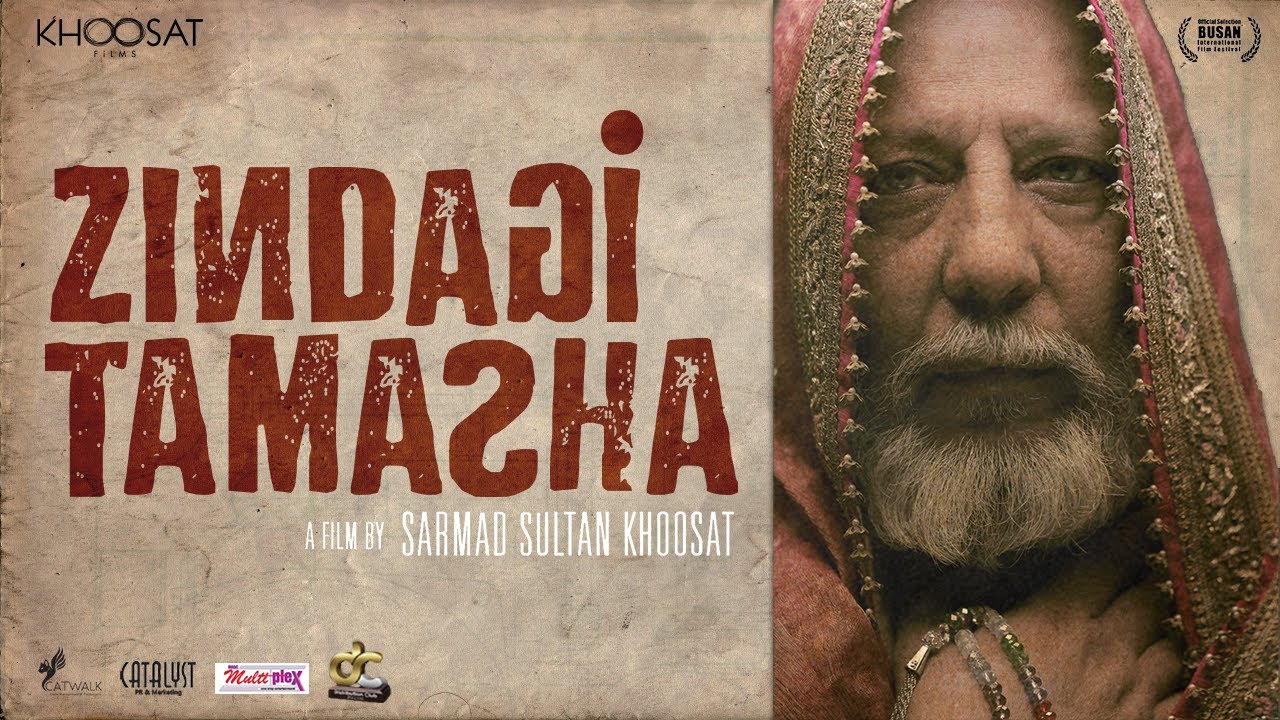
Sarmad Khoosat’s Zindagi Tamasha (2019) stands as a landmark in contemporary South Asian cinema for its unflinching exploration of morality, masculinity, and the politics of public shame. The film’s narrative centres on Rahat Khawaja, a devout and respectable man whose life collapses after a seemingly innocent video of him dancing at a wedding surfaces on social media. What begins as a moment of joy is transformed into an act of moral transgression, unleashing the full force of societal condemnation.
Through this deeply personal story, Khoosat offers a searing commentary on how fragile, performative, and punitive moral judgments can be—how easily a person’s dignity and humanity are undone by appearances, rumours, or a single perceived misstep.
At its core, Zindagi Tamasha exposes the hypocrisy that underpins collective moral policing. The society depicted in the film thrives on surveillance and spectacle; virtue becomes a public performance, and righteousness depends on visibility. The camera, however, refuses to participate in this violence of exposure.
Instead, Khoosat directs our gaze towards the affective aftermath—the silences, the spaces between humiliation and despair, and the slow disintegration of a man who once found stability in faith and community.
In this sense, the film becomes both mirror and critique, compelling viewers to recognise their own complicity in structures of judgment and exclusion.
A particularly radical intervention the film makes lies in its portrayal of men’s mental health, a subject rarely granted space in South Asian cultural narratives.
Rahat’s internal unraveling reveals the psychological cost of patriarchal expectations—the emotional repression demanded by the dictum mard nahi rote (“men do not cry”). His inability to express sorrow or vulnerability becomes both symptom and symbol of a masculinity defined through silence.
Khoosat visualises this suffocation through space and light: the once festive, music-filled lanes gradually narrow and darken, the brightness of early sequences replaced by greys and shadows. The city itself seems to close in on him, embodying his inner turmoil and the social claustrophobia of being morally exiled. The aesthetic transition from openness to enclosure mirrors his descent into loneliness and self-doubt.
The film’s emotional centre surfaces when compassion comes from an unexpected direction. In a society that abandons him, it is a transgender person who extends kindness—helping Rahat distribute food, an act that restores his sense of humanity and dignity. Khoosat’s decision to locate empathy on the margins rather than within the respectable moral order is deeply political.
It suggests that those most excluded from the social fabric are often the ones most capable of understanding pain, humiliation, and resilience. This moment dismantles the boundaries of gender and virtue, revealing the profound humanity that exists beyond structures of respectability.
Rahat’s subsequent attempt to reclaim social legitimacy only deepens his tragedy. In a desperate bid to prove his moral worth, he aligns himself with a police officer conducting a raid on a supposed “gay gathering.” The irony is piercing: the same society that vilifies him now demands his participation in the policing of others.
His performance of heteronormativity becomes an act of self-preservation, a futile attempt to re-enter a moral community that has already rejected him. Through this, Khoosat lays bare the cyclical nature of moral violence—how victims of judgment are coerced into reproducing the very hierarchies that destroy them.
The film’s use of sound and music intensifies its affective charge. The haunting soundtrack oscillates between devotion and melancholy, echoing Rahat’s divided self—between faith and fallibility, between the sacred and the shamed.
Music becomes both memory and mourning, amplifying the contradictions within him and within the society that condemns him. The family dynamic further complicates this moral terrain. The son-in-law, quietly empathetic, attempts to understand Rahat’s suffering, while the daughter becomes an agent of moral enforcement.
Her inability to accept her father’s actions, despite celebrating similar performances by male dancers on her television show, exposes the selective moralism and gendered double standards that define respectability. The public stage forgives what the private sphere condemns.
The film culminates in a scene of extraordinary tenderness and symbolic power. In anger and contempt, the daughter throws her late mother’s clothes at Rahat, taunting him to wear them since “that is what he likes to do.” Yet what could have been a moment of degradation transforms into something sacred.
Rahat dons his wife’s chappal, sweater, and cap, not as an act of submission but as a gesture of remembrance—a silent attempt to embrace her presence once more. The act collapses shame into grief, humiliation into love. Khoosat films this moment with minimal dialogue, allowing silence to speak where language fails. The gesture becomes a quiet rebellion against a world that has refused him compassion, transforming vulnerability into dignity.
In refusing spectacle even as it critiques it, Zindagi Tamasha performs an ethics of restraint. Its power lies not in confrontation but in the quiet, sustained attention it gives to suffering and humanity.
The film redefines strength through tenderness and faith through empathy. By tracing the slow suffocation of a man within the moral gaze of his community, Khoosat exposes how moral policing operates as both collective cruelty and personal erasure. The film’s resonance extends far beyond its narrative—its relevance deepened in an age where social media amplifies public shaming and moral outrage.
Ultimately, Zindagi Tamasha stands as a cinematic meditation on the fragility of human dignity and the violence of moral certainty. It asks us to rethink the ethics of judgment and to acknowledge that compassion, not condemnation, must remain the measure of a just society.
Through silence, symbolism, and the language of vulnerability, Khoosat transforms what could have been a story of disgrace into one of profound empathy. The film’s brilliance lies in its ability to translate moral inquiry into cinematic form—through sound, silence, light, and spatial constriction. In a world where the streets—literal and moral—continue to narrow, where social media thrives on public shaming and instant judgment, Khoosat’s film feels uncannily prophetic.
It asks us to reconsider the cost of our moral performances and the lives we flatten in the process. Zindagi Tamasha reminds us that the only way forward is through tenderness, understanding, and the courage to see one another in full.
The writer is a researcher and film programmer of South Asian Cinema. She can be mailed at toyebapandit@gmail.com



Comments are closed.