New Delhi, Aug 20: India’s defence and internal security posture has witnessed what the government is calling a “tectonic shift” over the last eleven years, with defence spending nearly tripling, record growth in indigenous production and exports, decisive counter-terror operations, and a roadmap for futuristic security systems that officials say will prepare the nation for the challenges of the next decade.
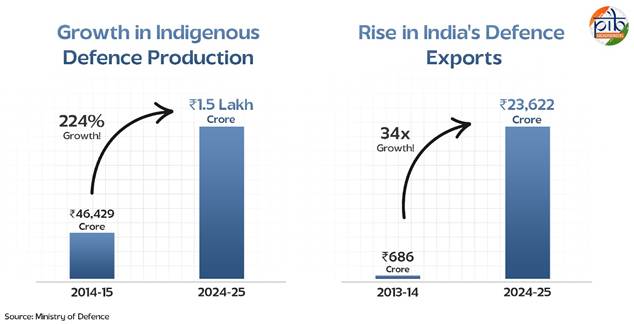
According to a background note issued by the Ministry of Defence, India’s annual defence outlay has risen from ₹2.53 lakh crore in 2013–14 to ₹6.81 lakh crore in the current financial year 2025–26. Indigenous defence production touched a historic ₹1.50 lakh crore last year, more than three times the level in 2014–15, while exports of Indian military equipment grew 34 times in the same period to ₹23,622 crore. Supplies now reach over 100 countries, including major powers such as the United States and France, marking what the government says is “a decisive move from dependency to self-reliance.”
“This government has made it clear that India will never depend on any other country for her security,” the note said, underlining reforms that have streamlined procurement, liberalised foreign investment, and opened the defence ecosystem to start-ups and MSMEs.
At the core of this drive is the Defence Acquisition Procedure (DAP) 2020, which gives priority to indigenously designed, developed and manufactured projects, while the ‘Make’ categories provide financial and regulatory incentives to domestic industry. Under these provisions, 146 projects have already been cleared across the Army, Navy, Air Force and Integrated Defence Staff.
To attract capital and advanced technology, foreign direct investment has been liberalised, with 74 per cent allowed under the automatic route and up to 100 per cent through approval for high-tech projects.
The government also pointed to the Strategic Partnership model of 2017, which enables Indian firms to collaborate with global defence majors for transfer of technology and joint production. The creation of platforms such as the SRIJAN portal for indigenisation and the identification of more than 5,000 items under positive indigenisation lists are being showcased as evidence of a decisive break from India’s past dependence on imports.
The note also highlighted the role of start-ups and academia, backed by the Innovations for Defence Excellence (iDEX) initiative launched in 2018 and the Technology Development Fund (TDF), which provides grants of up to ₹10 crore for advanced technologies.
More than 46,000 items once imported are now being developed locally, officials said, while Defence Public Sector Undertakings have drawn up AI roadmaps to integrate emerging technologies into their systems.
Alongside these structural changes, the government underscored a new and firmer line against cross-border terrorism. After the surgical strikes across the Line of Control in 2016 and the Balakot air strikes in 2019, the most significant operation came earlier this year.
Operation Sindoor, launched in May 2025 after the killing of civilians in Pahalgam, saw Indian forces using drones and precision munitions to hit nine terrorist camps in Pakistan and Pakistan-occupied Kashmir. More than a hundred militants, including men linked to the 1999 IC-814 hijacking and the Pulwama suicide attack, were killed. Pakistan attempted retaliation with drones and missiles, but Indian counter-drone systems intercepted them.
In his Independence Day address this year, Prime Minister Narendra Modi described the operation as “a new normal,” making it clear that any future attack on Indian citizens will be met with full force. Officials described Modi’s five “new normals” in dealing with Pakistan — firm response to terror, no tolerance for nuclear blackmail, holding terrorists and sponsors equally accountable, focusing any dialogue only on terrorism or Pakistan-occupied Kashmir, and zero compromise on sovereignty.
Looking to the future, the government has announced the Sudarshan Chakra Mission, a defence programme to be fully researched, developed and manufactured in India by 2035. Its goal, the note said, is to anticipate future warfare scenarios using predictive technologies and artificial intelligence, and to create a comprehensive national security shield for both strategic and civilian assets.
Internal security, too, was showcased as an area of “significant gains.” The Ministry said Left-Wing Extremism, once described as India’s most serious internal challenge, has been “brought under control.” The number of affected districts has fallen to fewer than 20, incidents of violence have dropped from 1,936 in 2010 to 374 in 2024, and civilian and security force casualties have declined by 85 per cent. More than 8,000 Naxalites have abandoned violence in the last decade. Officials credited not just security operations but also governance and development measures, such as roads, schools and welfare schemes, for reducing the ground for extremist mobilisation.
The note linked these advances to what it described as a wider definition of national security. Atmanirbharta, the government said, is no longer confined to defence but extends to food, technology, energy and financial resilience. Foodgrain production rose from 246 million tonnes in 2013–14 to 353 million tonnes in 2024–25, while milk production climbed more than 63 per cent in a decade, making India the world’s largest producer with a quarter of global output. The Pradhan Mantri Jan Dhan Yojana has opened over 56 crore bank accounts with deposits of ₹2.64 lakh crore, more than half of them belonging to women. The government also cited milestones such as the India Semiconductor Mission, which has attracted investments of ₹1.60 lakh crore and enabled the launch of indigenous 3-nanometer chip design centres this year.
“India today is a confident and resilient nation, prepared to meet traditional and non-traditional challenges, and on course to becoming the world’s third-largest economy by 2030,” the Ministry said, calling the transformation “not rhetoric, but resolve.” The note concluded that the shift reflects “the deep determination of the government to build a Viksit Bharat in every sense, with national security as its unshakable foundation.”


Comments are closed.